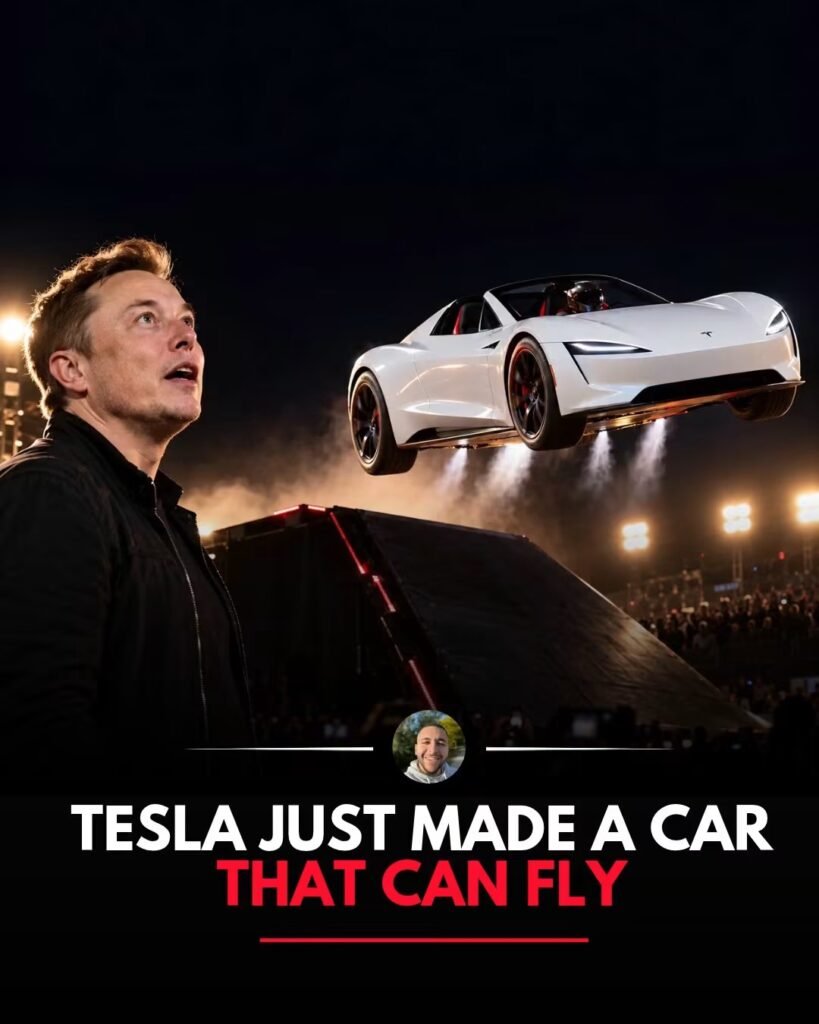

BREAKING: Tesla Unveils Its Most Audacious Roadster Yet — The Car That Flipped in Midair and Landed on Its Wheels
By TrendPeels Editorial Desk
SEO headline: Tesla Reveals Flying Roadster: What Is Real, What Is Hype, and How Much Will It Cost?
Meta description: Tesla’s new Roadster has stunned the internet with mid-air flips, rocket-style thrusters and a dramatic landing. Here is what we know about its technology, expected price, production timeline and whether it is truly a flying car.
Category: Technology, Automotive, Innovation
A CAR THAT APPEARS TO DEFY GRAVITY
Imagine watching a sports car accelerate towards a ramp, launch into the air, rotate dramatically and return to the ground on its wheels.
Now imagine that the vehicle is electric, has no driver inside during the demonstration and uses technology inspired by rocket engineering.
That is the spectacle surrounding Tesla’s redesigned Roadster, which has captured global attention following its unveiling in Texas on October 15, 2026.
The demonstration was unlike a conventional electric-car launch. Instead of simply showcasing acceleration, design and battery performance, Tesla presented a prototype capable of spectacular aerial manoeuvres using specialised thrusters developed with technology associated with SpaceX, the aerospace company led by Tesla chief executive Elon Musk.
Footage from the event has sparked excitement, disbelief and a familiar question about the future of transportation: Have flying cars finally arrived?
The short answer is that Tesla has demonstrated a vehicle capable of brief, controlled airborne manoeuvres. However, calling it a fully practical flying car would be misleading.
The distinction matters because the technology shown during a demonstration is not necessarily the same as a finished product that customers can buy, register and safely drive on public roads.
According to Reuters and The Associated Press, the redesigned Roadster is expected to enter production in 2028. That means the spectacular unveiling is an important milestone, but it does not mean customers can take delivery immediately.
So, what exactly did Tesla reveal? How does the vehicle leave the ground? What will it cost? And is this the beginning of a new era in automotive engineering?
TrendPeels takes a closer look.
WHAT HAPPENED AT THE TESLA ROADSTER REVEAL?
Tesla unveiled its redesigned second-generation Roadster at an event held at a SpaceX facility in Texas.
The presentation placed the vehicle’s extraordinary performance at the centre of attention. Rather than demonstrating only its ability to accelerate on a traditional road, Tesla showed a prototype performing manoeuvres that would be impossible for an ordinary passenger car.
The demonstration included the vehicle moving along an inverted ramp with assistance from a specialised suction system, launching into the air, rotating during the manoeuvre and returning to the ground.
The car was also shown using its thrusters to leap over other vehicles.
These demonstrations helped distinguish the new Roadster from conventional electric supercars, which generally rely on tyres, aerodynamic downforce, suspension and braking systems to control their movement.
Tesla’s approach combines electric-vehicle engineering with technology inspired by the aerospace industry.
The result is a dramatic showcase of what can happen when a high-performance road vehicle is equipped with specialised systems for producing thrust and controlling its movement beyond the road surface.
However, the demonstration should not be confused with proof that the car can fly over long distances, carry passengers through the air or operate as an everyday aircraft.
Those are separate engineering and regulatory challenges.
Reuters reported that Tesla expects production to begin in 2028, while noting that the company has previously faced delays with the Roadster programme.
That history makes the next stage of development just as important as the unveiling itself.
HOW CAN A TESLA ROADSTER FLY?
The most fascinating aspect of the new Roadster is not simply that it leaves the ground. It is how the vehicle generates the forces needed to perform the manoeuvre.
Conventional electric cars use battery-powered motors to turn their wheels. The tyres push against the road, allowing the vehicle to accelerate, brake and change direction.
A car that briefly lifts off the ground needs another way to generate force.
Tesla’s new demonstration vehicle uses rocket-style cold-gas thrusters developed with SpaceX-related technology.
Cold-gas propulsion works by releasing pressurised gas through a nozzle. As the gas is expelled, it produces thrust in the opposite direction.
By arranging thrusters in different directions, engineers can potentially influence the vehicle’s movement while it is airborne.
This is different from a conventional rocket engine that burns fuel to generate hot, high-speed exhaust. Cold-gas systems use stored pressurised gas, avoiding combustion in the propulsion system itself.
That does not automatically make the technology harmless. High-pressure gas storage, powerful exhaust, structural loads and the possibility of an uncontrolled landing all present significant engineering challenges.
The Roadster demonstration also featured a specialised suction system intended to help the car maintain contact with a surface, including an inverted ramp.
The combination of these technologies is what makes the vehicle particularly unusual.
The technology behind the spectacle
1. Cold-gas thrusters
These provide the thrust needed for short airborne manoeuvres. Their precise contribution depends on the final system’s design, thrust output and control software.
2. Directional control
Multiple thrusters can be arranged to generate forces in different directions. Coordinating those forces is essential when attempting a controlled rotation or landing.
3. A specialised suction system
Tesla demonstrated a system intended to hold the vehicle against a surface during unusual driving manoeuvres. This is not a feature of ordinary electric cars.
4. Electronic control systems
Any production version attempting such manoeuvres would need sophisticated monitoring and control to coordinate the vehicle’s movement. The precise production implementation and safety safeguards remain important questions.
The key point is that the Roadster does not simply become an aircraft because it can leave the ground. Its airborne capability is a specialised engineering function that must be evaluated separately from its everyday road-driving performance.
WHAT IS REAL, AND WHAT IS HYPE?
Viral technology stories often combine genuine demonstrations with predictions about what a product might eventually achieve.
The Tesla Roadster deserves the same careful examination.
What appears to be real
The October demonstration was reported by established automotive and news organisations, including Reuters, The Associated Press and The Verge.
The footage showed a prototype performing airborne manoeuvres, including a mid-air rotation and a landing. The event was not merely an anonymous social-media rumour.
Tesla also announced a production target of 2028, although a target is not a guarantee of delivery.
The vehicle’s use of rocket-style thrusters and a specialised suction system is central to the technology Tesla demonstrated.
What remains unproven
The demonstration does not establish that every customer Roadster will have the same airborne capabilities.
It does not establish that the car can fly for extended periods, travel significant distances through the air or carry passengers safely while airborne.
Nor does it establish that the vehicle can legally perform these manoeuvres on public roads.
A carefully controlled demonstration environment is very different from a busy road, where pedestrians, other vehicles, buildings and unpredictable traffic conditions create additional risks.
The final production configuration, real-world reliability, maintenance requirements and regulatory approvals will all matter.
Is it really a flying car?
That depends on how the term is defined.
If a flying car means a road vehicle that can briefly become airborne, the demonstration supports describing the Roadster as having an airborne capability.
If a flying car means a practical vehicle that can take off, transport passengers through the air, navigate safely and land at destinations like an aircraft, the available evidence does not establish that the Roadster meets that definition.
This is an important distinction for readers.
A spectacular jump or controlled mid-air flip can demonstrate a remarkable engineering achievement without proving that a vehicle is ready to replace an aeroplane or helicopter.
The headline-grabbing description is understandable, but the engineering details tell a more useful story.
THE BIG QUESTION: HOW MUCH WILL THE TESLA ROADSTER COST?
The price is one of the biggest unanswered questions surrounding the new Roadster.
Tesla’s earlier second-generation Roadster announcement in 2017 included a proposed starting price of approximately $200,000 for the standard vehicle, while a limited Founder Series was advertised at a substantially higher price.
However, those earlier figures should not automatically be treated as the confirmed price of the redesigned vehicle unveiled in 2026.
Reuters reported that Tesla had not announced a final purchase price at the October event.
The company’s reservation arrangements indicate different entry points for different configurations.
According to Reuters’ reporting on the current reservation programme:
- Performance version: a $50,000 reservation payment.
- Thrust version: a $250,000 reservation payment.
- Rocket version: described as an invitation-only configuration with a full flight system.
These figures are reservation payments, not confirmed final vehicle prices. A deposit is not the same as the total amount a buyer must pay to own a car.
Tesla’s reservation terms also state that the final purchase price will be confirmed later, when the buyer configures the vehicle and the applicable options and hardware are established.
That means prospective customers should be cautious about social-media posts presenting the reservation amount as the complete cost of the car.
What might Nigerian buyers pay?
For Nigerian readers, the exchange rate is another consideration.
The following figures illustrate the dollar amounts converted at a hypothetical exchange rate of ₦1,500 to $1. This is an example for comparison, not a live exchange-rate quotation.
| Amount | Approximate naira equivalent |
| $50,000 reservation payment | ₦75 million |
| $200,000 illustrative vehicle price | ₦300 million |
| $250,000 reservation payment | ₦375 million |
These conversions exclude shipping, import duties, customs charges, insurance, local registration and other possible costs.
They also do not mean that the car’s confirmed Nigerian selling price has been established.
If the final vehicle price is higher than the earlier estimate, or the exchange rate changes before deliveries begin, the actual cost could be substantially different.
For Nigerian enthusiasts, therefore, the Roadster is likely to remain an expensive luxury purchase even before its specialised hardware and import costs are considered.
HOW FAST IS THE NEW ROADSTER?
Tesla has long used the Roadster to demonstrate the performance potential of electric vehicles.
The redesigned version continues that approach, with acceleration claims that would put it among the most ambitious performance cars announced by the company.
At the October 2026 reveal, Tesla highlighted acceleration from zero to 60 miles per hour in less than one second.
That is approximately zero to 97 kilometres per hour in under a second.
If achieved under defined, repeatable test conditions in a production vehicle, such performance would be extraordinary.
However, the conditions behind an acceleration figure matter. Tyre grip, surface preparation, vehicle configuration, battery state, launch procedures and measurement methods can all affect the result.
A prototype demonstration is not a substitute for independent testing of a production model.
Tesla has also previously advertised a top speed above 250 mph for the Roadster programme. Reuters’ report on the redesigned vehicle cited a claimed top speed exceeding 230 mph, along with a range of more than 300 miles.
The final specifications must be confirmed for the version that customers actually receive.
These figures also highlight an important distinction: acceleration, top speed and airborne manoeuvrability are separate capabilities. Success in one does not automatically guarantee success in the others.
WHAT ABOUT BATTERY RANGE?
An electric supercar must do more than accelerate rapidly. It must also deliver usable range, charging performance and reliability.
Tesla previously advertised a range of up to 620 miles for its second-generation Roadster concept. The redesigned vehicle’s reported range of more than 300 miles represents a different target.
The figures should not be compared without accounting for changes in the prototype, battery configuration, testing conditions and vehicle hardware.
A propulsion system designed for airborne manoeuvres could introduce additional engineering demands, including weight, packaging, structural reinforcement and energy or gas-storage requirements.
Cold-gas thrusters do not work like the car’s ordinary electric motors. Their contribution to range depends on how the overall system is designed and used.
The company will need to demonstrate that the final car can balance performance with practicality.
For buyers, independent range tests and charging information will be more useful than headline specifications alone.
WHY THE DRIVERLESS DEMONSTRATION MATTERS
One detail that attracted attention was the absence of a person inside the vehicle during the demonstration.
That raises a reasonable question: Was the car autonomous?
A vehicle can perform a manoeuvre without a visible driver for several reasons. It might be remotely operated, run through a pre-programmed sequence, or controlled by a specialised test system.
The absence of a driver does not, by itself, prove that the vehicle has fully autonomous driving capability.
The Roadster’s airborne demonstration and Tesla’s broader self-driving ambitions are related to the company’s interest in advanced control systems, but they should not be confused with one another.
Driving autonomously on public roads involves interpreting traffic, detecting hazards, predicting the behaviour of other road users and making decisions under unpredictable conditions.
Controlling a planned stunt in a restricted demonstration area is a different problem.
The precise control arrangements used for the demonstration should be distinguished from any claims about the final production car’s autonomous capabilities.
For consumers, the critical questions are whether the vehicle will require a human driver, what driver-assistance functions it will offer, and what restrictions will apply to its specialised manoeuvres.
Those details matter far more than simply observing that no one was visible in the cockpit during a stunt.
WILL THE ROADSTER BE LEGAL ON PUBLIC ROADS?
This is where the excitement meets the practical realities of vehicle regulation.
A road-legal vehicle must comply with the relevant safety and equipment requirements in the jurisdiction where it is registered and operated.
A car equipped with specialised propulsion hardware faces additional questions about safe operation, system failure, maintenance, emissions or discharge rules where applicable, and risks to people nearby.
Even if a manufacturer can demonstrate a manoeuvre in a controlled setting, that does not automatically mean the same manoeuvre is permitted on public roads.
For the United States, federal vehicle requirements and state-level traffic laws are among the considerations that could affect the vehicle’s operation. Other countries have their own vehicle approval and road-use rules.
For Nigeria, any future imported version would need to satisfy the applicable vehicle importation, registration and road-use requirements. Special airborne operation would raise further questions that cannot be answered merely by pointing to a demonstration abroad.
The company has not established through the unveiling alone that every advertised manoeuvre will be approved for routine public-road use.
Potential buyers should therefore distinguish between the vehicle’s engineering capability and the activities legally permitted with it.
WHY IS TESLA DOING THIS?
The Roadster is more than a sports car. It is a statement about what Tesla wants people to associate with its technology.
The company became known for helping make electric cars desirable to consumers who wanted performance as well as lower direct driving emissions.
The original Roadster, introduced in the late 2000s, helped demonstrate that an electric vehicle could be a high-performance product rather than simply an economical alternative to a petrol-powered car.
The next-generation Roadster has been presented as an even more ambitious expression of that philosophy.
By bringing together electric propulsion and technology inspired by SpaceX, Tesla is attempting to show that its engineering ambitions extend beyond conventional automotive design.
There is also a marketing dimension.
An extraordinary vehicle demonstration can generate global attention, strengthen a company’s futuristic image and encourage people to discuss its products.
That does not make the engineering meaningless. A demonstration can be both a genuine technical achievement and a powerful marketing event.
But the value of the presentation ultimately depends on what follows.
A production vehicle must deliver the promised capabilities, meet safety requirements, reach customers and justify its price.
For investors, the Roadster’s symbolic importance may be different from its immediate financial impact. Reuters reported that Musk had previously characterised the programme as relatively small in financial terms for Tesla.
That helps explain why the vehicle can attract enormous public interest without necessarily being the company’s most important business priority.
HOW DOES IT COMPARE WITH ORDINARY ELECTRIC SUPERCARS?
Most electric supercars focus on acceleration, handling, braking, aerodynamic efficiency, battery performance and driver control.
The Roadster’s proposed airborne capability adds a different engineering challenge.
A conventional electric supercar depends on tyre contact with the road for acceleration and braking. Its aerodynamic systems help stabilise the vehicle at speed, but they do not ordinarily provide a mechanism for a controlled jump followed by a thruster-assisted landing.
The Roadster demonstration attempts to go beyond those conventional limits.
However, extra capability can also introduce extra complexity.
Specialised propulsion systems need to be engineered, inspected and maintained. Their weight and packaging can affect cabin space, vehicle balance and practicality.
A system that performs spectacularly during a short demonstration may also require limitations on how often it can be used and under what conditions.
The relevant comparison is therefore not simply which vehicle performs the most impressive stunt.
It is which vehicle can reliably deliver its advertised performance while meeting customer expectations for safety, comfort, maintenance, range and ownership costs.
Until independent tests of the production Roadster are available, comparisons with established electric supercars should remain provisional.
THE BIGGEST RISKS AND UNANSWERED QUESTIONS
Despite the excitement, several issues remain unresolved.
Production delays: The second-generation Roadster was first revealed in 2017, with earlier delivery expectations that were not met. The latest 2028 target is an announced plan, not a guaranteed delivery date.
Final pricing: Reservation payments have been reported, but the complete purchase price and final configuration costs remain unconfirmed.
Safety and reliability: Thruster-assisted manoeuvres introduce risks beyond those encountered in ordinary road driving. The production vehicle will need to demonstrate how these systems are controlled, maintained and restricted.
Practicality: The Rocket configuration’s specialised equipment could affect passenger space and everyday usability. The final specifications will determine how much of the demonstrated technology is available to customers.
Regulatory approval: A successful demonstration does not automatically confer permission to perform airborne manoeuvres on public roads.
Independent verification: Manufacturer performance claims need to be tested under clearly defined conditions before they can be treated as established production specifications.
These are not reasons to dismiss the Roadster. They are the questions that separate an exciting prototype from a dependable commercial product.
WHAT THIS MEANS FOR THE FUTURE OF TRANSPORTATION
The Roadster demonstration arrives at a time when automotive companies are experimenting with increasingly sophisticated technologies.
Electric powertrains have already changed expectations about acceleration and vehicle packaging. Advanced driver-assistance systems, automated driving research and aerospace-inspired engineering are pushing the industry into new territory.
But the future of transportation will not be determined by dramatic demonstrations alone.
Successful technologies must solve real problems at an acceptable cost.
For a flying vehicle, those problems include how it takes off and lands, where it can operate, how it avoids obstacles, how it carries passengers, how it handles emergencies and how authorities regulate its use.
A road car that can perform a brief airborne manoeuvre may be an important engineering experiment without being the answer to traffic congestion.
The Roadster could help demonstrate new ways of combining vehicle control and specialised propulsion. It could also encourage other engineers to investigate similar ideas.
Whether those ideas eventually become practical consumer products remains an open question.
For now, the most defensible conclusion is that Tesla has demonstrated an unusual prototype, not that ordinary road travel has already been replaced by personal flight.
FINAL VERDICT: A REAL DEMONSTRATION, BUT NOT YET AN EVERYDAY FLYING CAR
Tesla’s redesigned Roadster has delivered one of the most unusual sports-car demonstrations in recent memory.
Its mid-air manoeuvres, specialised thrusters and dramatic landing show how far engineers are willing to push the boundaries of conventional electric-car design.
The event was real, and the technology deserves serious attention.
However, the viral description of a car that can fly should not obscure the difference between brief airborne stunts and a practical flying vehicle.
The final production specifications, safety arrangements, road approvals, pricing and delivery schedule still matter.
Tesla has indicated that production is expected to begin in 2028, while its reported reservation payments start at $50,000 for the Performance version and $250,000 for the Thrust version. Those payments are not the confirmed total purchase prices.
For now, the Roadster is best understood as a highly ambitious electric supercar prototype with demonstrated airborne capabilities and significant questions still to answer.
If Tesla delivers the promised technology in a production-ready form, it could become a remarkable chapter in automotive engineering.
But until customers can independently verify its capabilities and understand the restrictions governing its use, the safest headline is not that flying cars have completely arrived.
It is that Tesla has taken another dramatic step towards testing what a car might be able to do.
What do you think? Is Tesla’s Roadster the beginning of a new era in transportation, or is the flying-car label getting ahead of the technology? Share your thoughts with TrendPeels.
EDITOR’S NOTE
This article is based on reporting available as of October 17, 2026. Performance figures, production plans and reservation arrangements may change. The reported reservation payments should not be presented as final vehicle prices. The Roadster’s demonstrated airborne manoeuvres should not be interpreted as proof of unrestricted flight capability or universal approval for public-road operation.
SOURCES FOR EDITORIAL VERIFICATION
- Reuters — reporting on Tesla’s redesigned Roadster, SpaceX-inspired thrusters, production target and reservation arrangements.
- The Associated Press — reporting on the demonstration and regulatory questions surrounding the vehicle.
- The Verge — analysis of the Roadster’s specialised propulsion system and practical limitations.
- Tesla — Roadster information and reservation terms.
SUGGESTED SOCIAL-MEDIA CAPTION
🚨 TESLA’S NEW ROADSTER JUST TOOK THE INTERNET BY STORM!
A car that flips in midair and lands on its wheels? Tesla’s latest Roadster demonstration has reignited the debate over whether flying cars are finally becoming reality.
But what is actually confirmed, what remains hype, and how much will it cost?
TrendPeels breaks down the technology, reported reservation payments, expected production timeline and the big questions Tesla still needs to answer.
👇 Read the full story and tell us: Would you trust a car that can leave the ground?
#TrendPeels #Tesla #Roadster #ElonMusk #FlyingCar #ElectricVehicles #TechnologyNews #Innovation