
.
By Dickson Omobola | Edited for TrendPeels | October 16, 2026
Category: Aviation • Nigeria News • Safety Investigation
Aircraft loses door shortly after take-off from Abuja
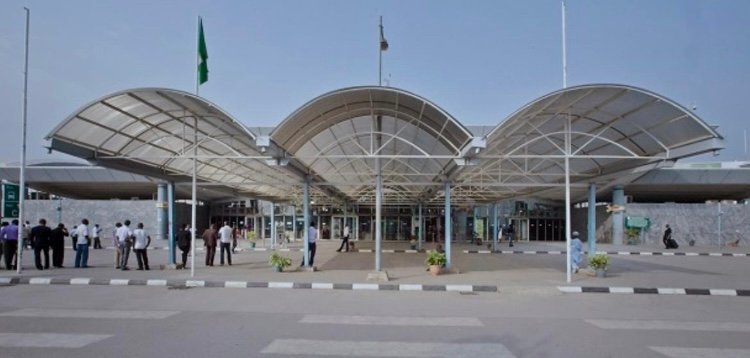
A CL60 aircraft operated by Triton Aviation has made an emergency landing at the Nnamdi Azikiwe International Airport, Abuja, after its crew reported that a door had opened during flight, triggering a Mayday distress call and an emergency response at the airport.
The aircraft, identified by registration number T7-SEI and flight identification DWC052, was travelling from Abuja to the Murtala Muhammed International Airport in Lagos on Thursday, October 15, when the incident occurred shortly after departure.
According to an air traffic control incident report cited by Nigerian media organisations, the aircraft departed Runway 22 at approximately 4:17 p.m. Coordinated Universal Time (UTC). About three nautical miles from the airport, while climbing through 3,000 feet, the crew transmitted a distress call at approximately 4:20 p.m. UTC.
The crew reportedly informed air traffic controllers that a door had opened in flight. Controllers subsequently directed the aircraft back to Abuja, where it landed safely on Runway 22 at approximately 4:34 p.m. UTC.
The incident prompted airport emergency personnel, including fire and rescue teams and medical staff, to prepare for the aircraft’s return.
The Nigerian Safety Investigation Bureau (NSIB) confirmed that investigators had been deployed to examine the incident, according to reports published on Friday, October 16.
The cause of the door opening or detachment remains unestablished, and the number of people on board had not been confirmed in the reports available at the time of publication.
Source: Vanguard report by Dickson Omobola; Premium Times report.
The flight began as a departure from Nigeria’s capital for the country’s commercial centre, Lagos. However, within minutes of take-off, the crew reported a problem serious enough to require an immediate return to the departure airport.
The aircraft was climbing away from Abuja when the distress call was transmitted. The incident report placed the aircraft approximately three nautical miles from the airport and at an altitude of about 3,000 feet when the crew declared an emergency.
The reported sequence of events is significant because the aircraft was still relatively close to the airport when the problem emerged. This enabled air traffic controllers to direct the aircraft back to Abuja rather than have it continue towards Lagos.
The crew’s decision to communicate the problem and request assistance allowed air traffic control to coordinate the aircraft’s return and prepare emergency services on the ground.
Aviation emergencies require pilots to assess the condition of an aircraft while communicating essential information to controllers. They must consider the nature of the problem, the aircraft’s handling characteristics, the available landing options and the safest course of action.
In this case, the reported door problem led to the decision to return to the airport.
The incident also illustrates why a flight crew’s report of a serious technical problem must be treated with urgency, even when the aircraft remains airborne and appears capable of continuing its flight.
At the time of the initial reports, there was no verified information establishing whether the door first became unsecured before detaching or whether another mechanical failure occurred.
Investigators will need to determine precisely what happened rather than rely on assumptions about the sequence of events.
Mayday call triggers emergency response
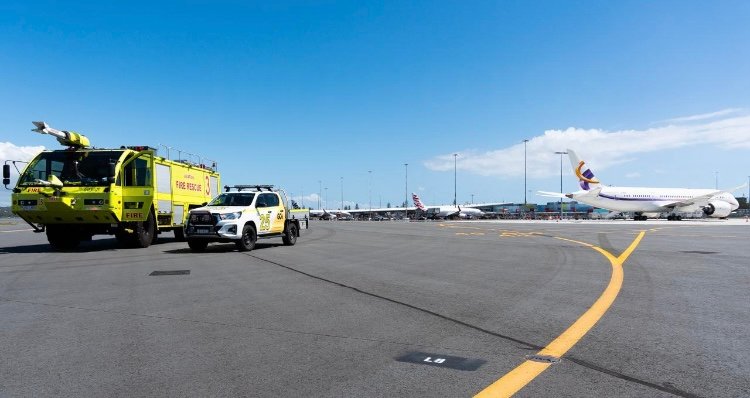
Illustrative image: Airport fire and rescue teams prepare for an aircraft emergency. This is not a photograph of the specific Abuja incident.
One of the most critical moments in the incident came when the crew transmitted the internationally recognised distress call, “Mayday, Mayday, Mayday.”
The call signals that an aircraft faces grave and imminent danger and requires immediate assistance. It alerts air traffic control to prioritise the aircraft and coordinate the necessary response.
According to the incident report cited by Nigerian media, the distress call was made at about 4:20 p.m. UTC. The aircraft was then directed back to Abuja for an emergency landing.
At approximately 4:22 p.m. UTC, airport fire personnel and the medical team were reportedly notified and placed on standby. Fire and rescue units were instructed to position themselves at designated points identified as A4 and A5.
Such preparations are an important part of airport emergency procedures. Fire and rescue teams must be ready to respond if an aircraft experiences difficulties during approach, landing or taxiing.
Medical personnel may also be positioned to provide immediate assistance if anyone requires treatment.
The activation of emergency services does not, by itself, mean that a crash or injuries occurred. It is a precautionary measure intended to ensure that the necessary support is available if the landing does not proceed as expected.
In the Abuja incident, the aircraft ultimately landed safely, according to the available reports.
The rapid coordination between the flight crew, air traffic controllers and airport emergency personnel will therefore be an important part of the overall account of how the emergency was managed.
The investigation should also establish whether all applicable emergency procedures were followed and whether any operational lessons can be drawn from the incident.
Crew asked whether the control tower could see the door
A particularly notable detail in the incident report emerged at approximately 4:29 p.m. UTC, when the crew asked the Abuja control tower whether controllers could see if the aircraft’s door was open.
The duty air traffic controller reportedly attempted to observe the aircraft using binoculars. However, the controller could not establish the condition of the door because of the aircraft’s position.
The crew was informed that the controller could not visually confirm the situation.
This exchange highlights the limitations of visual observation during an in-flight emergency. Air traffic controllers can coordinate an aircraft’s movements, communicate instructions and activate emergency response arrangements, but they may not be able to inspect every part of an aircraft from the ground.
The crew’s request also demonstrates the importance of communication when pilots need information that may help them understand the condition of their aircraft.
However, the inability to confirm the door’s position visually did not prevent the return to Abuja from proceeding.
The aircraft continued towards the airport and landed safely at approximately 4:34 p.m. UTC, according to the incident report.
After the aircraft landed, the duty controller could see that the door was missing from the fuselage.
That observation provided further evidence that the problem was more serious than an unconfirmed indication of an open door.
It remains for investigators to determine the precise sequence of the failure, including when the door became detached and what condition the aircraft was in during its return.
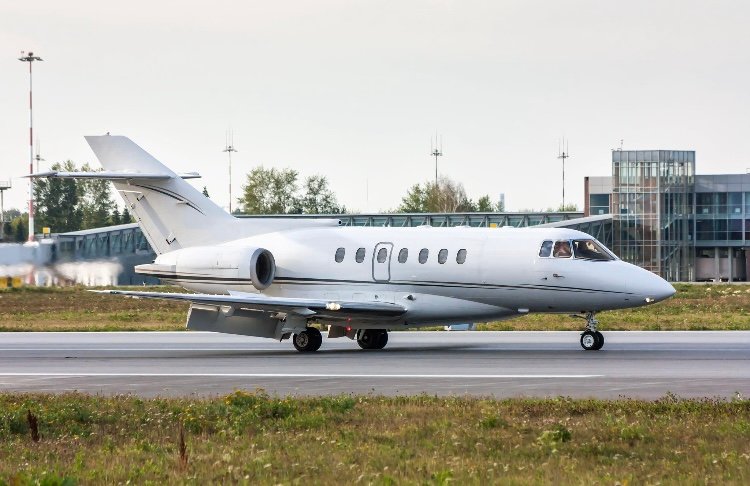
Aircraft lands safely after 14 minutes
Illustrative image: A business jet taxiing after landing. The photograph does not depict the Triton Aviation aircraft.
The aircraft landed on Runway 22 at approximately 4:34 p.m. UTC, about 14 minutes after the Mayday distress call.
Following the landing, the aircraft was taxied to the international apron extension, where it was parked with the assistance of a marshaller, according to the reported incident details.
The successful landing brought the immediate airborne emergency to an end. However, it did not resolve the questions surrounding the reported loss of the aircraft door.
A safe landing following a serious technical incident is an important outcome, but aviation safety investigations must go further. Investigators need to establish why the incident occurred, whether other components were affected and what measures may be required to prevent a recurrence.
The aircraft’s condition after landing will be central to that process. Investigators may need to examine the affected area of the fuselage, the door and its locking mechanisms, the relevant maintenance records and any technical data available from the flight.
The precise examinations undertaken will depend on the investigators’ findings and the aircraft’s configuration.
The reported sequence also shows the value of keeping an aircraft close to an appropriate airport when a serious problem emerges shortly after departure. In this case, the aircraft was directed back to the airport from which it had taken off.
No conclusion about the cause of the incident should be drawn solely from the fact that the aircraft landed safely.
Aviation incidents can involve several contributing factors, and only a properly conducted investigation can determine whether the event resulted from a mechanical defect, a maintenance issue, an operational factor or a combination of circumstances.
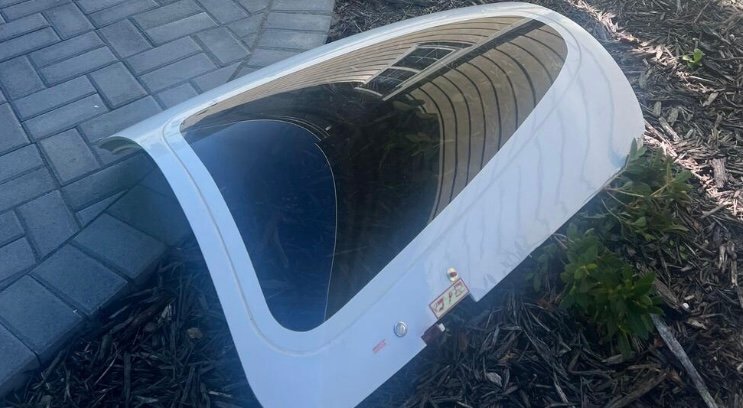
Missing door reportedly found on farmland in Abuja
Illustrative image only: A detached aircraft door on farmland. This is not a verified photograph of the component reportedly recovered near Abuja.
The incident took another turn after videos circulated online showing a large object described by people in the footage as an aircraft door reportedly found on farmland in the Abuja area.
In footage described in reports by Nigerian media, an unidentified man said farmers had discovered the object while returning from their farm.
The man reportedly explained that they believed it had fallen from an aircraft but did not provide independently verified details about its identity or the circumstances surrounding its discovery.
The reported discovery has attracted attention because it raises questions about where the component landed and whether investigators have been able to establish its connection to the Triton Aviation aircraft.
However, the precise location of the discovery, the chain of custody of the component and its identification must be established through proper verification. The circulating video, on its own, does not conclusively establish every detail of the object’s origin.
If the component is confirmed to belong to the aircraft, it could provide investigators with important physical evidence.
A door recovered away from an airport may preserve clues about the failure, including damage to the door, its hinges or attachment points, its locking mechanisms and the surrounding structure.
Investigators may also compare the recovered component with the aircraft’s remaining structure and technical records.
Such examinations can help determine whether the door was properly secured before departure, whether a component failed during flight or whether another event caused the door to separate from the aircraft.
These are investigative questions, not established explanations for what happened.
The recovery of the door, if officially confirmed, could also help establish the aircraft’s path at the time the component separated. Flight data, radar information and other available evidence may help investigators narrow down the location and timing of the event.
The circumstances surrounding the reported discovery should therefore be treated carefully until the relevant authorities provide further details.
Related reporting: The Guardian’s account of the Abuja incident and The PUNCH’s report.
What does the CL60 designation mean?
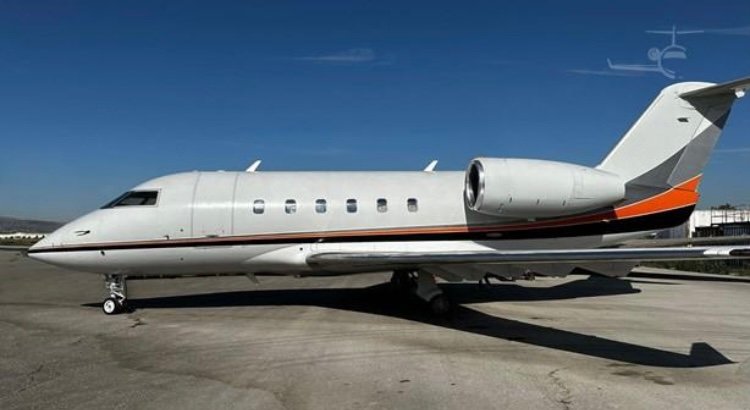
The aircraft involved has been identified in reports as a CL60. This designation is associated with the Bombardier Challenger 600 series of business jets.
Illustrative image: A Bombardier Challenger-series business jet, not confirmed to be the aircraft involved in the incident.
Aircraft doors are also safety-critical components. Depending on the door’s design and function, its assembly may include latches, locking mechanisms, seals, hinges or other structural attachments.
The condition and correct operation of these components are important to the safe operation of an aircraft.
However, it would be premature to conclude that a particular locking mechanism, hinge or seal failed in the Abuja incident. The precise aircraft configuration and the type of door involved must be established before any technical explanation can be made.
Aviation safety assessments also distinguish between an initial report of a door opening and the later confirmation that the door was missing from the aircraft. The first describes what the crew reported during flight; the second reflects the observation made after landing.
That distinction matters because investigators must reconstruct the event from evidence rather than assume that the first report explains the entire failure.
The registration number T7-SEI and flight identification DWC052 will help authorities identify the specific aircraft and flight in their investigation.
Why an aircraft door problem is a serious safety concern
A door opening or detaching during flight is not an ordinary operational inconvenience. Its seriousness depends on the door’s location, design, the extent of any structural damage and the aircraft’s condition at the time.
An aircraft door is designed to remain securely attached and sealed under the conditions for which the aircraft is certified. A failure may affect the surrounding structure, cabin environment or operation of nearby systems, depending on the circumstances.
If a door or another large component separates from an aircraft, it can also create a hazard for people or property on the ground.
These potential consequences explain why the crew’s report triggered a distress call and why airport emergency teams were placed on standby.
At the same time, it is important not to exaggerate what is known about this particular incident. The available reports establish that the crew reported a door problem, the aircraft returned to Abuja and the aircraft landed safely. They do not, by themselves, establish the extent of any cabin-pressure change, structural damage or injuries.
Those details require confirmation.
Aviation safety depends on the ability to identify a hazard, respond appropriately and investigate the underlying cause. The fact that an aircraft can remain airborne and land after a component failure does not mean that the failure can be dismissed.
Equally, a serious technical incident does not automatically mean that the aircraft was on the verge of crashing. The actual risk must be assessed using evidence about the aircraft, the nature of the failure and the crew’s response.
For this reason, the investigation into the Abuja incident will be important not only for determining what happened on the flight but also for identifying any safety measures that may be necessary.
NSIB deploys investigators as aviation authorities respond
Illustrative image: Aviation investigators examining an aircraft. It is not a photograph of the NSIB team at Abuja Airport.
The Nigerian Safety Investigation Bureau has emerged as a key institution in the response to the incident.
According to reports published on October 16, the bureau confirmed that the incident occurred and said investigators had been deployed. The agency was expected to provide further information as the investigation progressed.
The Nigeria Civil Aviation Authority (NCAA) also reportedly confirmed the incident through its Director of Public Affairs and Consumer Protection, Michael Achimugu. However, the NCAA indicated that the investigation fell under the responsibility of the NSIB.
The distinction between the two agencies is important.
The NCAA is responsible for civil aviation regulation and oversight, while the NSIB investigates aviation accidents and serious incidents to establish their circumstances, causes and contributing factors and to support improvements in safety.
An investigation into an event of this nature may involve examining the aircraft, reviewing maintenance documentation, interviewing relevant personnel and analysing available operational information.
Investigators may also seek information about the aircraft’s recent maintenance history, the inspection of the affected door and the procedures followed before departure.
The exact scope of the investigation will depend on the evidence collected and the findings of the investigating authority.
At the time of the reports cited in this article, Triton Aviation had not provided a publicly reported detailed explanation of the incident. The number of people on board also remained unconfirmed.
It is important that any eventual conclusions be based on technical evidence and the findings of the competent authorities rather than speculation circulating on social media.
An investigation should establish what happened and identify any relevant safety lessons. It should not begin with an assumption that a particular person, company or maintenance procedure was responsible.
Questions investigators will need to answer
Although the aircraft’s safe return to Abuja is a significant part of the incident, several questions remain unanswered.
The first concerns the precise sequence of events. Did the door initially become unsecured, or did it separate from the aircraft through another failure? What did the crew observe, and at what point did they become aware of the problem?
The second concerns the door itself. Investigators will need to establish its identity, its condition and whether the locking and attachment mechanisms were operating as intended before departure.
The third concerns the aircraft’s maintenance history. Relevant records may help investigators establish what inspections had been carried out, whether any work had recently been performed on the affected component and whether any earlier defects had been reported.
These are routine lines of inquiry in a technical investigation; they are not allegations that maintenance was inadequate.
Another question concerns the aircraft’s condition during the return to Abuja. Investigators may examine available flight information and crew reports to understand how the problem affected the flight and what measures were taken to manage it.
The reported recovery of a door on farmland may also be relevant if the component is positively identified as belonging to the aircraft.
Finally, investigators will need to determine whether the incident has implications beyond this particular aircraft. If the evidence reveals a wider technical or procedural concern, the appropriate authorities may consider whether further inspections or safety recommendations are necessary.
Not every investigation results in a finding of widespread risk. The evidence must determine whether the event was isolated or points to a broader issue.
The public should therefore await verified findings before drawing conclusions about the operator, the aircraft type or Nigeria’s aviation safety system as a whole.
What the incident means for private aviation in Nigeria
Private and charter aviation plays a role in connecting business travellers, organisations and individuals across Nigeria and beyond. Like scheduled commercial aviation, these operations depend on airworthiness requirements, trained personnel, maintenance procedures and effective safety oversight.
The Abuja incident has drawn attention to the safety of private aircraft because it involved a serious technical problem shortly after take-off.
However, one reported incident is not sufficient to establish that private aviation in Nigeria is generally unsafe. A meaningful assessment would require reliable data on incidents, aircraft operations, maintenance, regulatory compliance and the outcomes of safety investigations.
What the incident does reinforce is the importance of effective oversight across all forms of civil aviation.
Aircraft operators must ensure that their aircraft are maintained in accordance with applicable requirements and that any defects are properly assessed. Flight crews must be trained to recognise and respond to emergencies, while regulators must carry out their oversight responsibilities.
Investigators, meanwhile, need access to the relevant evidence and the independence required to reach conclusions based on facts.
Transparency is also important. Timely, accurate public information can help prevent rumours from filling the gap while an investigation is ongoing.
In a case involving a component reportedly falling from an aircraft, the public may reasonably want to know whether the component has been recovered, whether it has been identified and whether any additional safety measures are necessary.
Providing verified updates as the investigation progresses can help address those concerns without compromising the technical process.
The importance of a safe return and a thorough investigation
The CL60’s reported return to Abuja demonstrates the importance of coordinated action when a serious in-flight problem occurs.
The crew reported the problem, air traffic control directed the aircraft back to the airport, and emergency personnel were placed on standby. The aircraft subsequently landed safely.
Those actions helped bring the immediate emergency to an end, but the wider safety questions remain.
Aviation safety is not measured only by whether an aircraft reaches the runway. It also depends on understanding why a component failed, determining whether other aircraft could face similar risks and taking appropriate action when the evidence warrants it.
For the investigators, the priority will be to reconstruct the event using the aircraft, relevant records, operational information and any recovered component that can be verified.
For Triton Aviation, the incident will require cooperation with the investigating authorities and any necessary technical examinations.
For the relevant aviation agencies, the focus will be on establishing the facts and determining whether any regulatory or safety follow-up is needed.
And for the public, the most useful response is to distinguish verified information from unconfirmed claims while awaiting the findings.
What we know so far
Aircraft returned safely to Abuja
The CL60 operated by Triton Aviation landed on Runway 22 at approximately 4:34 p.m. UTC on October 15, 2026, according to the reported incident details.
Distress call made shortly after take-off
The crew reportedly declared a Mayday emergency at approximately 4:20 p.m. UTC while the aircraft was climbing through 3,000 feet.
Investigation initiated
The NSIB confirmed that investigators had been deployed, according to media reports published on October 16.
Cause remains undetermined
The precise cause of the door opening or detachment, the number of people on board and the circumstances surrounding the reported recovery of the component require further verification.
Conclusion: Abuja aviation scare raises questions that demand answers
The emergency involving the Triton Aviation CL60 has placed an important aviation safety question in the spotlight: how did an aircraft door reportedly open and detach shortly after take-off, and what measures may be needed to prevent a similar incident?
The aircraft’s safe landing was a positive outcome, but the event warrants a careful, evidence-based investigation.
The findings should clarify the circumstances surrounding the reported door failure, establish the role of any technical or operational factors and identify any necessary safety recommendations.
Until the investigating authorities release further verified information, claims about the cause of the incident or responsibility for it should be treated with caution.
For now, the key facts are that the aircraft reported a door problem, declared an emergency, returned to Abuja and landed safely. The investigation will determine the full story behind those events.
TrendPeels will continue to follow developments and report verified updates as further information becomes available.
Pictures and publication notes for TrendPeels
The images included above are illustrative images, not verified photographs of the incident aircraft or the investigation. For a stronger news publication, use the following authentic visuals if permission and source verification are available:
Main image: A verified photograph of the Triton Aviation CL60, registration T7-SEI.
Second image: The actual aircraft after landing at Nnamdi Azikiwe International Airport.
Third image: A verified photograph of the door reportedly recovered from farmland.
Fourth image: An official photograph or statement from the NSIB.
Editorial note: This TrendPeels version is an expanded feature based on reported information, not an independently conducted investigation. Confirm the latest NSIB findings before publishing it as a final, fully updated report.